
title: Tempo strength with cadence description: 3-1-3 push-ups, 5-1-3 squats — set up cadence patterns that count beats, not seconds.
Tempo strength with cadence
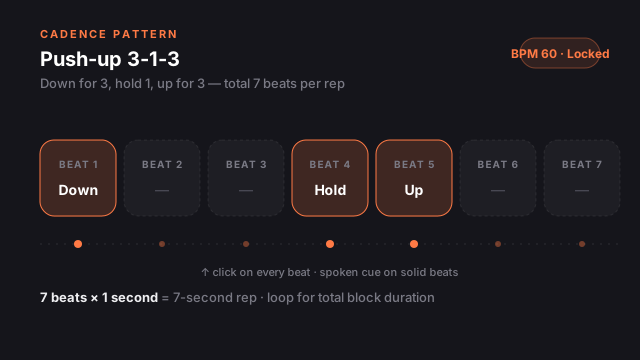
Tempo strength is strength training where the time under tension on each rep matters as much as the load. 3-1-3 push-ups (3 seconds down, 1 hold, 3 up) hit your muscles differently than a regular push-up, even with the same weight and rep count. RhythmFit speaks the rep on the beat so you don't have to count in your head.
If you haven't read it yet, the cadence pattern concept page covers the data format. This page is the how-to.
The 90-second version
Library → Strength → Tempo Strength 3-1-3 starter
A ready-to-run 12-minute template: warm-up, 3 × push-up, 3 × squat, 3 × hollow hold, cool-down.
Tap Start
BPM auto-pins to 60 for the tempo blocks. You hear "Down · · · Hold · Up · · ·" every 7 seconds.
That's it
You've done a tempo workout. Read on if you want to author your own.
Authoring your own tempo block
The recipe — same shape every time.
Create a workout
My tab → + → Create manually. Name it whatever you want.
Add a warm-up block
Phase
warmup, 5 minutes, BPM 130. (Warm-up isn't tempo — it's prepping the joints, light cardio.)Add a tempo block
Phase
work, label e.g. "Push-up 3-1-3", duration 35 seconds for 5 reps. Tap the cadence row, enter:["Down","","","Hold","Up","",""]BPM locks to 60 automatically.
Add a rest block
Phase
rest, label "Rest", duration 30 seconds, BPM 80.Duplicate the work/rest pair for additional sets
Long-press the work block → Duplicate. Repeat for the rest. Three sets is a common starting point.
Add pre-block notes (optional but recommended)
Tap the tempo block → Pre-block notes. Two technique cues for push-ups:
- "Hands shoulder-width, fingers forward" (
.technique) - "Keep your hips in line, no sagging" (
.safety)
Toggle Await confirmation on the first set so you can read the cues before starting. Off for sets 2 and 3 — you already know.
- "Hands shoulder-width, fingers forward" (
Add a cool-down and save
Phase
cooldown, 3 minutes, BPM 100. Save.
Choosing a tempo
The pattern length is your rep length. Rep length × number of reps = how long the block needs to be. Some common pairings:
| Movement | Pattern | Rep length | Block for 5 reps |
| -------------- | ---------------------------------------------------- | ---------- | ---------------- |
| 3-1-3 push-up | ["Down","","","Hold","Up","",""] | 7 s | 35 s |
| 4-1-1 squat | ["Down","","","","Hold","Up"] | 6 s | 30 s |
| 5-1-3 deadlift | ["Down","","","","","Hold","Up","",""] | 9 s | 45 s |
| 2-0-2 bench | ["Down","","Up",""] | 4 s | 20 s |
| 30 s plank | ["Hold","","","","","","","","",""] (looped) | 10 s | 30 s |
Beginners: start with shorter tempos (2-0-2, 3-0-3) and 3 reps per block. The point isn't volume — it's nailing the cadence.
When to use Learning Mode confirmation
Turn on the confirmation step for:
- The first block of a new movement you're still teaching yourself.
- Any block whose pre-block notes contain safety cues a beginner might miss.
Don't turn it on for:
- Every block — the constant "Got it" tap kills flow.
- Rest blocks — they don't have pre-block notes anyway.
A common pattern: confirmation on set 1, off for sets 2+. The cue content stays available but the rhythm doesn't pause.
Asking the AI to build one
You can hand this entire structure to AI Create with one prompt:
"20-minute upper-body tempo strength workout. 3-1-3 push-ups and 2-1-2 dips. 3 sets each. 5-minute warm-up, 3-minute cool-down. Beginner — include safety notes on form."
The AI fills in the blocks, BPM 60 on the tempo blocks, pre-block
notes with .safety and .technique kinds, and rest blocks between
sets. You can then refine: "Make the rest blocks 45 seconds", "Drop
the dips, add diamond push-ups", and so on.